
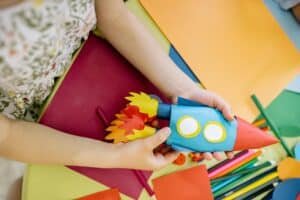
Creativity is more than craft projects and drawing pictures. Creativity is a way of thinking. Research shows that creativity leads to higher resiliency in kids because creativity relates to problem-solving abilities. “The more a child believes in their powers of creativity, the more they believe that whatever happens to them, they can overcome it because they can figure out a way to survive,” states Angus Fletcher, professor of English and leader of Ohio State University’s Project Narrative which studies creativity in kids. Children who have developed the ability to think creatively show greater capacity toward problem-solving, innovation, resilience, and expression of their feelings.
Moreover, research shows creativity scores in children have been declining since 1990 compared with previous generations, most notably in grades K-3. What can parents and caregivers to do reverse this trend and cultivate creativity in their young children? Here are some simple suggestions for parents and caregivers may nurture their child’s creative thinking.
Play all day 
Unstructured, free play is the form of play most beneficial to a child’s creative development. Unlike board games or sports which have rules and goals (and are beneficial for different reasons), free play allows children to choose the rules of their own games, encouraging creative thinking, problem-solving, and social awareness. If you join in their play, allow the child to take the lead and set the parameters of the play.
Having a dedicated play area, even if it is just a corner of a room, with open-ended toys will help inspire your child to engage in free play. Provide simple blocks, magna-tiles, or other building toys; costume materials such as hats or jewelry (can be from a thrift store); and paper, crayons, tape, and recycled materials such as fabric scrapes, cardboard, empty paper towel rolls for artistic inspiration.
Allow Mistakes
Show children that making mistakes is a part of learning. Mistakes are not failures, but an opportunity to try again in a new way. One way to model this for your children is to ask your child to “teach” you about something they are learning or a new game. The parent should then deliberately make a mistake and let the child help them. The child feels empowered that they can help, and also sees the parent, who is supposed to know everything, not hampered by their mistake but still asking questions and trying to learn.
See Things from a Different Perspective
If you ask your child how many different (play) uses they can find for a paper plate, their answers might surprise you. It can be a frisbee, a hat, a sled, a pizza, a fan – the list goes on. Play a game with your child where they have to find a way across a room without touching their feet to the ground. Maybe they scoot and wiggle on their bellies; maybe they find pillows to hop across like stepping stones; maybe they have a sibling pull them by their feet so that they slide on their bottom, or roll them on their side. Allow yourself to join in thinking of new possibilities and seeing creative solutions.

Limit Screens
Although screens can be a useful tool, passive consumption from screens prevents boredom which in turn can limit creativity. Although boredom typically has negative associations, research shows a positive connection between boredom and the development of free thinking and creativity. Encourage your children to be active players and not passive consumers.
Schedule your tour of Intrinsic Scholars Academy to see what Intrinsic Scholars can do for you and for the development of your child’s creativity.