
Developmental Milestones Parents Should Look For
Some children are early walkers, talkers, or readers. Some children want to do everything like their big siblings while others like to just watch.
Every child develops at their own pace, but developmental milestones are one way that pediatricians and parents can anticipate upcoming skills and ensure each child is developing in a timely manner.
What Is a Developmental Milestone?
A developmental milestone is the approximately expected level of gross and fine motor skills, mental and emotional skills, cognition skills, and social skills for the age of the child. These will build on each other over time to accomplish greater strength, coordination, and comprehension.
The Centers for Disease Control and Prevention has a list of age-appropriate developmental milestones that many pediatricians use as a guideline in tracking developmental progress. These are not an absolute standard–in fact, they were revised in 2022! Many children eventually develop normally, even if they are “behind” in certain areas.
While developmental milestones aren’t something to stress over, they can be helpful in determining necessary care and therapy if a milestone is missed or delayed. If a pediatrician notes these delays, your child may qualify for beneficial therapy or healthcare procedures that will benefit their quality of life.
Why Parents Should Know Developmental Milestones
Because most children only see their pediatricians at well visits, months or even a year can go by before a pediatrician examines and observes your child. Even then, the pediatrician relies heavily on the parent’s subjective report because they can only observe so much in a 30-minute appointment.
Parents and guardians, then, need to know what to expect in the age range (or upcoming age range) of their child so they can give an accurate report. Many pediatricians’ offices will provide a handout of these milestones.
You must be honest at the pediatrician’s office. The pediatrician is on your child’s side! Even if your child isn’t meeting developmental milestones, the pediatrician is the one who can help, so sharing honestly can only benefit your child.
2 Months
By two months old, babies should be able to look at your face and be happy to see you. They should make other sounds than crying and be startled by loud noises. They should watch you move around the room and look at toys for several seconds at a time. They can hold their head up when lying on their tummy, move both arms and legs and open and close their hands.
 4 Months
At four months, babies can smile, chuckle, and make cooing sounds. They will look at their hands with interest and recognize that a bottle or breast means food. They can hold their head up, put their hands in their mouth, use their arms to swing at toys, and hold themselves up on their forearms while on their tummy.
6 Months
Your 6-month-old should be laughing, love looking at himself in a mirror, and recognize familiar people. They can squeal, take turns with you making sounds, and blow “raspberries.” They can reach for toys and put them in their mouths, roll from tummy to back, push up on straight arms when on their tummy, and can sit (leaning on hands for support if necessary).
 9 Months
At 9 months, your baby may be shy or fearful of strangers and react when you leave by crying or reaching for you. They will laugh at peek-a-boo, show various facial expressions (like happy, sad, mad), and respond to their name. They will say repeated sounds like “mama” or “baba” and lift their arms to be picked up. They will look for objects dropped out of sight, bang objects together, and transfer objects from one hand to another. They can get into a sitting position and sit unsupported.
12 Months
At a year old, babies play pat-a-cake, wave “bye,” say “mama” and “dada,” and understand “no”–even if they don’t listen! They like to put things in a container and look for objects you hide under a blanket as a game. They will pull to stand, cruise alongside furniture, pick up food between their thumb and pointer finger, and drink from a cup with help.
15 Months
Around 15 months, toddlers love to copy what other children do, show you their toys, clap, stack objects, and show physical affection to toys and loved ones. They may say one or two other words, like “da” for dog. They will look at objects when you name them, follow simple directions (“give me the toy”), and point to someone or something for help. They may be stacking steps on their own and feeding themselves.
18 Months
Toddlers at 18 months point at interesting things, play away from you, look at books, and know how to help you dress them. They try to say more words and follow one-step directions. They copy your chores and mannerisms. They walk on their own, climb on and off a couch, scribble, and try to use utensils.
2 Years
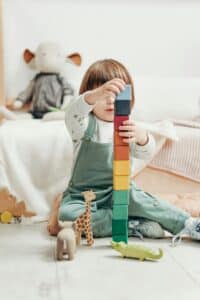
At 2 years, toddlers pay more attention to social situations by acting sad when others cry or look to see your reaction to a new situation. They can point to familiar objects in a book, say two words together (“more milk”), point to two body parts, and gesture more often with blowing kisses or nodding yes. They are interested in knobs and switches, playing with more than one toy at a time, running, kicking a ball, walking up steps, and eating with a spoon.
30 Months
At 2.5 years, toddlers begin to play with other children instead of beside them. They can follow a simple routine (“it’s time to clean up”) and like to get your attention to watch them. They can say about 50 words, using a noun and verb together like “doggie run.” They can tell you the names of objects in books and say “I,” “me,” and “we.”
They begin to play imaginatively and use simple problem-solving skills. They can follow two-step instructions like “shut the door and take off your coat.” They can identify at least one color. They begin to use their hands to twist things, take off some clothes independently, jump with both feet and turn pages in a book.
3 Years
3-year-olds can self-soothe within 10 minutes of childcare drop-off, and play with other children. You can begin to have simple conversations, and they ask “who,” “what,” “where,” or “why” questions. They can identify an action in a book like running or jumping. They say their first name and talk well enough for other adults to understand them.
They can draw a circle, string large beads on a string, use a fork, and put on some clothes independently. They avoid touching objects like a hot stove when instructed.
4 Years
Young children pretend to be something else during play, like a superhero or ballerina. They comfort a sad friend, avoid dangerous situations like jumping from a tree, like to help, and can change behavior based on their surroundings (home vs. school).
Their sentences are four or more words long, ask simple questions, and can tell you something about their day. They can name colors, tell what comes next in a story, and draw a person with three or more body parts. They can catch a large ball, serve their food, unbutton buttons, and hold their utensil and pencils in a pencil grasp.
 5 Years
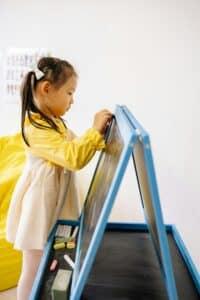
Children at this age can play games with simple rules, act or dance, and do simple chores. They can tell simple stories, answer simple questions, keep a conversation going with up to four exchanges, and recognize simple rhymes.
They can count to 10, recognize some written numbers and letters, and write some letters in their name. They can pay attention for 5 to 10 minutes, use words about time like “yesterday” or “afternoon,” button some buttons, and hop on one foot.
Developmental milestones should be used as a tool to help you and your pediatrician evaluate your child’s development. Some children develop faster than others, and some develop quicker in some areas and not others–like a socially aware child who is a late walker.
If you have concerns about your child’s development, speak with your pediatrician! They can best assist you.
At Intrinsic Scholars Academy, we have a well-rounded curriculum for every age group that helps them meet their developmental milestones. We provide many opportunities throughout the day for children to develop fine and gross motor skills, cognitive skills, and social and emotional skills. Book a tour today!
Pretend Play
Pretend play more than just playing “house” or imagining you are flying a spaceship; for kids, it is actually a brain workout. Pretend play it is critical for cognitive development, social-emotional skills, and fostering creativity–and it’s a lot of fun.
 What Is Pretend Play?
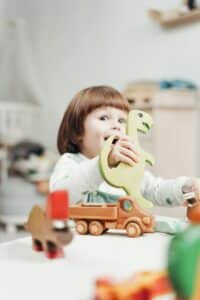
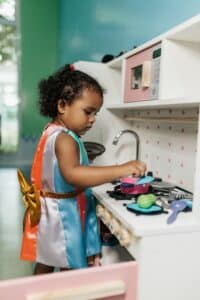
Also known as imaginative play, pretend play is when children create a unique story that usually includes toys or other items, and sometimes friends or siblings. This story unfolds with twists and turns, all according to the child’s inspiration and invention.
Although we tend to think toddlers and young children are the only ones who need pretend play, children of all ages benefit from it! Further, children of all ages should be encouraged to participate in imaginative play, even if they seem to have outgrown it.
What Makes Pretend Play Special?
What’s so important about pretend play? Here are just a few benefits to letting the imagination run playtime:
-
Cognitive development: Growing the imagination grows a child’s brain. It engages problem-solving, symbolic thinking, and
 language development.
 -
Social skills: As children act out their play physically and verbally, their communication skills are growing. Vital skills like cooperation, empathy, negotiation, and kindness are all being developed.
-
Emotional intelligence: Expressing their own emotions and understanding the emotions of others increases a child’s emotional intelligence. This will help them better navigate the emotions of their peers and develop empathy.
-
Creativity: Pretend play unleashes creativity, where anything is possible in the mind of the child. This primes children for formal education and being introduced to many new concepts and subjects.
Finally, children who engage in pretend play early and often are better equipped to handle academic and social challenges, putting them ahead of their peers.
 How To Encourage Pretend Play
If you’re ready to encourage pretend play, here are a few tips to set up your child for imaginative success:
-
Set technology boundaries: The ultimate killer to pretend play is phone, television, or tablet time. Who would rather create their own ideas when dazzling stories are spoonfed one swipe at a time? Set boundaries for technology to allow several hours of non-screen time. Children need time and space to be bored, which unleashes creative play
-
Provide open-ended toys: Toys with built-in lights and sounds are fun to buy but hamper creativity. Open-ended toys like blocks, pretend food and dishes, and dress-up clothes can be used whichever way the child chooses. Additionally, children can use all sorts of “recycled” materials, like empty yogurt containers or toilet paper rolls, string, or rubber bands to further imaginative play.

-
Don’t give too many suggestions: Although your child might need help getting started, don’t offer too many suggestions to their creative play. If you step into problem-solve for them, they will become dependent on you to keep the creative ball rolling.
-
Encourage outdoor play: If possible, encourage your child to play creatively outside. Playing outside opens up a new world of possibilities–children can climb, run, construct, and collect nature items. Plus they get fresh air, vitamin D, and you get a little peace and quiet.
Pretend Play at Intrinsic Scholars
At Intrinsic Scholars Academy, we know the importance of imaginative play. Each classroom is stocked with age-appropriate open-ended toys that children love to play with. Each classroom has scheduled time for free play, so children can grow their imaginations every day. Book a tour to see what Intrinsic Scholars can offer your family.
Supporting Your Child’s Emotions During the Holidays
The holidays are filled with excitement, but changes in routine, loud gatherings, busy schedules, and high anticipation can bring out some big emotions in children. At daycare and at home, supporting children’s emotional well-being during the holiday season helps them feel safe and understood. Here are some practical tips for steadying your child’s emotions during the holidays.
 Recognize the Impact
Even joyful events can stir up strong emotions. The holidays can be difficult because of disrupted sleep and meal times, separation from familiar environments, overstimulation from big events, excitement mixed with frustration or disappointment, and the pressure to behave “perfectly” in front of others. Recognizing that these may have an outsized impact on your child is the first way to help your child regulate.
Start with a Good Breakfast
Breakfast is the most important meal of the day, and this is especially true for children. The first things we feed our bodies in the morning has a huge impact on our blood sugar regulation for the entire day. Eating a meal with lots of protein and healthy fats is one of the best ways for children–and adults–to have good energy and stability throughout the day. When you eat only carbs for breakfast–like pancakes with syrup, or cereal with skim milk, French toast, a muffin–the your body rapidly breaks them into glucose, causing a high blood sugar spike because there’s no fat, protein, or fiber to slow digestion. This looks like a spike in energy–which is why children are hyperactive after a sugary breakfast–but high blood sugar is dangerous for the body. In response, the pancreas releases lots of insulin to bring the blood sugar down quickly, and this results in a quick energy crash (sometimes called a “sugar crash”), leaving you feeling tired and craving carbs soon after. You crave another sugary snack that is broken down into glucose and the cycle continues.
When you eat fat and protein first thing in the morning, however, blood sugar rises at a steady rate and is maintained throughout the day. No hyperactivity spike from sugar, no crash, and no complaining about being hungry in 45 minutes. Here are some breakfast ideas ideal for steady blood sugar and energy:
- Eggs prepared any way — scrambled, fried, hard-boiled, soft-boiled
- Bacon — try chopped bacon cooked into scrambled eggs
- Sausages links or patties — pair beautifully with eggs
- Avocado on whole grain 0r sourdough toast
- Full-fat yogurt with berries
- Fruit smoothie made with protein powder and full-fat milk or yogurt
- Breakfast sandwich with egg, bacon, and cheese
If these don’t sound like your typical holiday breakfasts, simply aim to serve your child something savory containing fat and protein alongside the cinnamon rolls or whatever other special holiday breakfast is served.
Try to Avoid Sugar-Only Snacks
Although breakfast is the most important meal for avoiding a blood sugar spike, snacks make an impact too. An afternoon Christmas cookie has the potential to cause a blood sugar spike and subsequent crash. If your child is having a rice crispy treat as a snack, try to pair it with a meat stick, some cheese, or some carrots and hummus alongside. If nothing else, give your child some full-fat milk alongside and this will help slow the sugar absorption. Cookies and milk pair well together for a reason!
Keep Routines as Normal as Possible
While schedules may shift during the holidays, children thrive when they know what to expect. Try to maintain regular bedtimes and nap times when possible. Keep familiar mealtime routines and try not to feed your child right before putting them to sleep. Continue daily rituals like reading before bed or quiet play after nap time. Even small consistencies help children to feel grounded.
Help Children Know What to Expect
Talking about holiday plans ahead of time can help reduce anxiety. Explain who they will see and where they will go. Let them know what will stay the same, like coming back to daycare, or bedtime routines. Consider showing your child a visual schedule so they can preview what is to come. When children know what to expect they can avoid worrying about unknowns and also be excited about upcoming events.
Create Quiet Moment
Balance excitement with regular periods of rest and quiet. Build a time of quiet into each day with calming activities like puzzles,coloring, or reading. Encourage deep breaths, stretching, or a cozy corner to help reset overwhelmed nervous systems. A regular time of reading aloud to your children can help everyone slow down and enjoy the connection the holidays should bring.
Give Children Choices
Offering small choices to children helps them feel like their opinions and preferences are important. Let children choose between multiple options, all of which would be acceptable with you as the parent or caregiver. Instead of letting them choose their entire outfit — which may or may not be appropriate for the Christmas concert — let them choose between the green sweater or the red sweater, or what color bow you put in your little girl’s hair. Let your child choose how they would like to eat their eggs (“scrambled or fried?”), or what wrapping paper to buy for their cousin’s gifts, or what Christmas carols to sing when you go caroling at the nursing home. Taking your child’s preferences into consideration is a way to make them feel valued.
Model Healthy Emotional Expression
Children learn by watching adults. Show them that big emotions are manageable by talking about your own feelings in simple ways. Demonstrate calming strategies like taking deep breaths, or politely requesting to have a moment to yourself. Model staying patient during stressful moments, and being thankful even in circumstances that are not ideal.
 Let’s Work Together
At Intrinsic Scholars Academy, our priority is to help children feel safe and assured through routine and connection. We recognize that when children express big emotions, it doesn’t mean they are misbehaving, it means they are communicating. We all need to slow down and pay attention to what children are telling us they need, and work to support their emotional well-being. With patience, empathy, and consistency, the holiday season can be a time of emotional growth and joyful connection. And when families and caregivers work together, children feel secure across all environments, even during busy seasons. If you have questions about our care, please reach out to our daycare team.
Holiday Neighbor Gifts You Can Make with Your Children
The holiday season is a wonderful time to teach children about kindness, generosity, and thinking of others. Creating simple gifts for neighbors and teachers alongside your child is a wonderful way to help them learn the blessedness of giving while caring for your community. Here are some gift ideas that are simple, affordable, and perfect for your child to help with.
1. Ornaments Made by Children
 Handmade ornaments make a thoughtful and meaningful gift, and the activity of making them doubles as a fun Christmas craft for your little ones. Simple wooden shapes —like these from Michaels — can be painted, or just colored with markers and decorated with stickers. Clear glass ornaments make a classy yet whimsical option and can be filled with glitter, pom poms, or paint. Or simple, traditional, and economical salt dough ornaments can be made at home with just flour, salt, and water. They finish feeling wholesome and artisan — the opposite of a consumeristic Christmas.
2. Sweet Treats
Of course baked goods are a classic neighbor gift, but you don’t have to fill an elaborate tin with 23 different kinds of cookies for this to be a special and sweet present. Cookies, muffins, holiday bark, or even granola are simple options that children can mix, scoop, or decorate. Package treats in festive decorative bags or clear cellophane bags tied with colorful ribbon. This year our family made salted toffee to give as gifts and it turned out beautifully. The recipe uses just butter, sugar, chocolate, and sea salt, and takes just 15 minutes (and then some time to set). The nuts look beautiful but we skipped them to make it more allergen-friendly. One tip is to make sure you have a reliable candy thermometer, because the only trick to success is to make sure the sugar and butter mixture fully reaches the hard crack stage, which is 300 degrees Fahrenheit.

3. Hot Cocoa Kits
A more specific kind of sweet treat idea is a hot cocoa kit, a gift that is both fun and practical. Fill a small jar or bag with cocoa mix (either from scratch or pre-packaged), marshmallows, and a candy cane. Children love to help scoop ingredients or to decorate the packaging. A tag decorated or “signed” by your child makes this gift personal and whimsical.
4. Bulbs or Seed Packets
Seed packets or spring flower bulbs are a thoughtful reminder that warmer days are coming. Children can help decorate envelopes or make plant identification markers to include with the gift.
5. Candles
The Dollar Tree has many beautiful little candles that can be decorated with ribbon and a tag and given as an easy but very appreciated gift. Alternatively, add tea lights or votive candles to small jars to make it more customized. Children can decorate wrapping or add gift tags.

6. DIY Household Gifts
Homemade sugar scrubs –even more fun if they are holiday themed–make a luxurious-feeling gift while still remaining budget friendly. Simmer pot kits can easily be assembled with oranges, cinnamon sticks, and cloves. To make simmer kits even fancier, add cranberries, anise, and rosemary sprigs. Children can help assemble the ingredients.
Intrinsic Scholars Academy is here to support your family’s needs and help you feel better connected to your community. Book a tour to learn what Intrinsic Scholars has to offer.
Five Ways to Enjoy the Holidays Without Leaving Home
While the holidays are an exciting and magical time, sometimes we feel pressure that in order to make fun and lasting memories we need to go out and do things with our children. But in fact, some of the most meaningful memories are made at home. Here are some easy and heartwarming ways to enjoy your days off at home with your children.
1. Create a Festive Atmosphere
Social media is buzzing with influencers clamoring to sell you their best Amazon decor pieces, but decorations your kids remember and enjoy the most are the ones you pull out year after year. “Oh here is the Santa pitcher! And the old Santa mugs!” Ornaments hold memories and are best enjoyed for years. One of the best ways to make holiday magic for your kids is to hold onto special things for years to come.
Twinkle lights that start before the day gets dark, Christmas scents from candles or diffusers (this is a favorite holiday essential oil blend), and a playlist with gentle holiday music can make the atmosphere festive and magical.

2. Bake a Simple Treat Together
The holidays are the time for baked treats, and children love to help. Here are 50+ Christmas treats ideas to make with your kids, and some tips on baking with children so the time is enjoyable for all:
- Select a few simple recipes your child to choose from. Preselecting helps you avoid getting stuck making chocolate filled croissants from scratch, but also gives your child the fun of choosing what to make.
- Read the recipe from start to finish before you begin.
- Reinforce safety rules, such as washing hands before beginning, and asking permission before using the oven or stove.

- Embrace the mess. The memories and learned skills for your child are worth it!
- Choose larger bowls. This can prevent spills when younger children are stirring.
- Assign specific tasks. Measuring dry goods and letting a child pour them into the bowl is a way to help a young child feel involved but doesn’t compromise on the result.
- Have your child participate in cleanup, either as you go or at the end.
 3. Read Holiday and Winter-Themed Books
Ezra Jack Keat’s The Snowy Day, Jan Brett’s The Mitten, and Susan Jeffer’s illustrations for Stopping by Woods on a Snowy Evening are all beautifully illustrated and delightful wintery children’s books. Start a collection of wintery and holiday books you pull out year after year and keep these books easily accessible in a basket for the season.
4. Start a Holiday Home Tradition
Traditions don’t have to be big. A few ideas:
- Hot chocolate Fridays
- A holiday movie marathon — or simply, re-watching classics like the 1966 How The Grinch Stole Christmas!
-
A family pajama day
These small rituals become treasured memories year after year.
5. Have a “Travel the World” Night From Home
Talk about how families around the world celebrate winter holidays. You can listen to music from different cultures, learn simple greetings, or try a special snack. It’s a fun, engaging way to build curiosity and cultural awareness.
Remember that the holidays do not have to be hectic. Some of the best moments happen in the quiet–watching the snow fall, having a slow Saturday morning in pjs, snuggling under the blanket looking at a book. Kids remember the feeling of warmth and connection more than anything else.
If you are interested in finding more about Intrinsic Scholars Academy, contact us and book a tour today.
Are Nightlights Disrupting Your Child’s Sleep?
Many children desire nightlights to feel safe and comfortable at bedtime. Nightlights can help a child feel less anxiety at bedtime, may ease the transition to sleep, and can help them navigate the room easily if they need to use the bathroom or to find a parent. But nightlights also have some downsides, and in some cases can impact your child’s sleep quality and duration.

Blue Light Inhibits Sleep
Sleep research shows that light exposure is all important in how the body prepares for rest. Not all colors of light have the same effect. Blue light, which is what our eyes are exposed to when we go outside around midday, is beneficial for alertness, reaction time, and mood. But these same qualities that are excellent for a productive day are disruptive at night when the body should be preparing for sleep. Melatonin, the hormone that influences circadian rhythm (the body’s biological clock) and which causes the body to go into deep sleep, is disrupted especially by blue light at night. In other words: blue light at night directly lowers melatonin production, leading to impaired sleep.
Harvard researchers conducted an experiment comparing the effects of 6.5 hours of exposure to blue light to exposure to green light of comparable brightness. The results showed blue light suppressed melatonin for twice as long and shifted circadian rhythms by twice as much (3 hours vs. 1.5 hours) compared to the green light. Another study found that students who looked at an LED tablet for 2 hours exhibited a 55% decrease in melatonin and an average melatonin onset delay of 1.5 hours compared to reading a printed book under low light.
Blue Light Exposure for Preschoolers
Among preschoolers, one shocking study found that playing games on a light table in the hour before bedtime, a posture similar to a person looking at a glowing phone or tablet, suppressed melatonin 70-99%. Surprisingly, the researchers found little-to-no relationship between how bright the light was and how much the key sleep hormone fell. “Even in response to light measured at 5  to 40 lux, which is much dimmer than typical room light, melatonin fell an average of 78%. And even 50 minutes after the light extinguished, melatonin did not rebound in most children tested.” Meaning, for over 50 minutes after the light was turned off, still melatonin was suppressed, making sleep difficult or impossible.
The author of the study stated: “Together, our findings indicate that in preschool-aged children, exposure to light before bedtime, even at low intensities, results in robust and sustained melatonin suppression.”
Night Lights

Since blue light before bed disrupts sleep, it is not surprising to find that blue light in the room while your child is trying to fall asleep is also disruptive. Dr. Brian Chen, sleep specialist and MD for the Cleveland Clinic, states that nightlights can significantly impact a child’s sleep. A totally dark room is always ideal. However, he offers suggestions for parents if their child really does seem to need a night light.
- Turn down the brightness to the lowest setting
- Choose a red or orange-colored light if possible (research shows red light at night does not disrupt melatonin)
- Place the light close to the ground and make sure it does not illuminate the ceiling
Another option is to have the nightlight slowly time out as the child goes to sleep so that once they are sleeping the room is completely dark.
Closing Thoughts
Parents should be mindful about their child’s exposure to blue light before bedtime, knowing that it will impact their child’s biological sleepiness cues and is likely to affect sleep quality and duration. If night lights are necessary, making sure the light is a low, warm-colored light will help. The good news is that drastically improved sleep may be achievable with some minor tweaks to your child’s bedtime routine.
Intrinsic Scholars Academy is here to help your child feel and perform their best every day. Book a tour today to learn more about what Intrinsic Scholars has to offer.