
Many children desire nightlights to feel safe and comfortable at bedtime. Nightlights can help a child feel less anxiety at bedtime, may ease the transition to sleep, and can help them navigate the room easily if they need to use the bathroom or to find a parent. But nightlights also have some downsides, and in some cases can impact your child’s sleep quality and duration.
Blue Light Inhibits Sleep
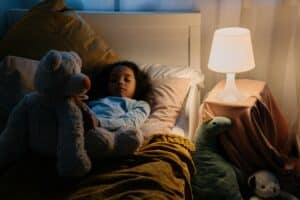
Sleep research shows that light exposure is all important in how the body prepares for rest. Not all colors of light have the same effect. Blue light, which is what our eyes are exposed to when we go outside around midday, is beneficial for alertness, reaction time, and mood. But these same qualities that are excellent for a productive day are disruptive at night when the body should be preparing for sleep. Melatonin, the hormone that influences circadian rhythm (the body’s biological clock) and which causes the body to go into deep sleep, is disrupted especially by blue light at night. In other words: blue light at night directly lowers melatonin production, leading to impaired sleep.
Harvard researchers conducted an experiment comparing the effects of 6.5 hours of exposure to blue light to exposure to green light of comparable brightness. The results showed blue light suppressed melatonin for twice as long and shifted circadian rhythms by twice as much (3 hours vs. 1.5 hours) compared to the green light. Another study found that students who looked at an LED tablet for 2 hours exhibited a 55% decrease in melatonin and an average melatonin onset delay of 1.5 hours compared to reading a printed book under low light.
Blue Light Exposure for Preschoolers
Among preschoolers, one shocking study found that playing games on a light table in the hour before bedtime, a posture similar to a person looking at a glowing phone or tablet, suppressed melatonin 70-99%. Surprisingly, the researchers found little-to-no relationship between how bright the light was and how much the key sleep hormone fell. “Even in response to light measured at 5 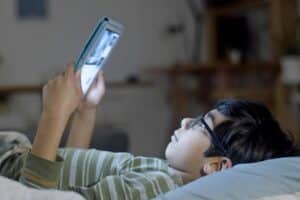 to 40 lux, which is much dimmer than typical room light, melatonin fell an average of 78%. And even 50 minutes after the light extinguished, melatonin did not rebound in most children tested.” Meaning, for over 50 minutes after the light was turned off, still melatonin was suppressed, making sleep difficult or impossible.
The author of the study stated: “Together, our findings indicate that in preschool-aged children, exposure to light before bedtime, even at low intensities, results in robust and sustained melatonin suppression.”
Night Lights
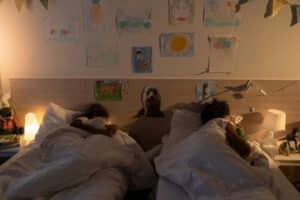
Since blue light before bed disrupts sleep, it is not surprising to find that blue light in the room while your child is trying to fall asleep is also disruptive. Dr. Brian Chen, sleep specialist and MD for the Cleveland Clinic, states that nightlights can significantly impact a child’s sleep. A totally dark room is always ideal. However, he offers suggestions for parents if their child really does seem to need a night light.
- Turn down the brightness to the lowest setting
- Choose a red or orange-colored light if possible (research shows red light at night does not disrupt melatonin)
- Place the light close to the ground and make sure it does not illuminate the ceiling
Another option is to have the nightlight slowly time out as the child goes to sleep so that once they are sleeping the room is completely dark.
Closing Thoughts
Parents should be mindful about their child’s exposure to blue light before bedtime, knowing that it will impact their child’s biological sleepiness cues and is likely to affect sleep quality and duration. If night lights are necessary, making sure the light is a low, warm-colored light will help. The good news is that drastically improved sleep may be achievable with some minor tweaks to your child’s bedtime routine.
Intrinsic Scholars Academy is here to help your child feel and perform their best every day. Book a tour today to learn more about what Intrinsic Scholars has to offer.